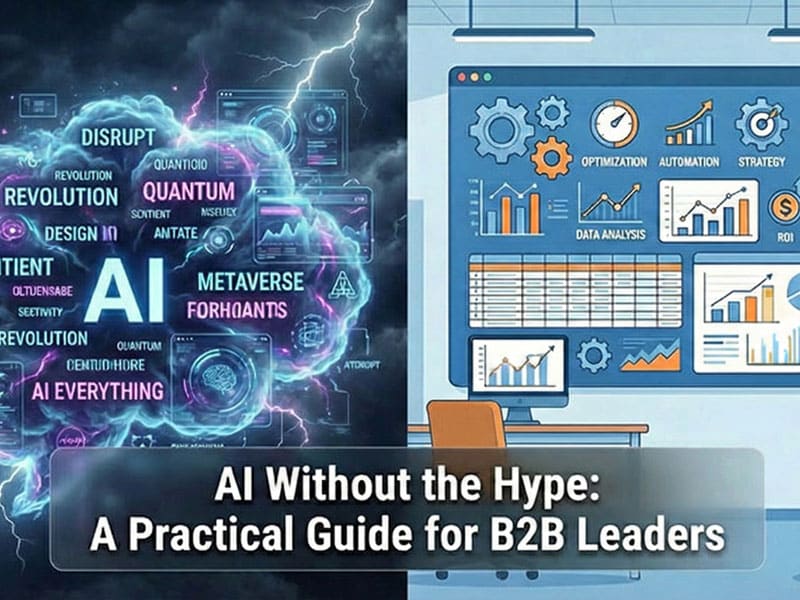
The Hidden Cost of AI Hype: What Leadership Teams Should Actually Be Asking About AI in 2026
Every leadership meeting follows the same script now. Someone mentions AI. Everyone nods seriously. Someone else references a competitor’s AI announcement. Panic sets in. The CFO asks about budget. IT mentions they’re “exploring options.” Marketing says they’re already using “several tools.” Nobody admits they have no idea what’s actually happening.
Welcome to 2026 where AI has become the business equivalent of saying you’re “data-driven” in 2015. Everyone claims it. Nobody can really define it. And the gap between what companies say they’re doing with AI and what they’re actually accomplishing would be hilarious if it weren’t so expensive.
The hidden cost of AI hype isn’t just wasted budget on tools nobody uses. It’s the opportunity cost of asking the wrong questions entirely.
The Questions Everyone’s Asking (That Don’t Actually Matter)
Walk into any boardroom and you’ll hear the same questions on repeat. “What AI tools are our competitors using?” “Should we implement ChatGPT Enterprise?” “Can we get an AI strategy deck by next week?” “What’s our AI roadmap?”
These questions feel productive. They sound strategic. They’re completely missing the point.
Asking what AI tools competitors are using is like asking what brand of hammers they bought without knowing what they’re building. Fascinating information. Utterly useless for decision-making. Your competitor might be using the fanciest AI tools on the market while their actual business operations remain a dumpster fire. Copying their tool stack won’t fix your problems. It’ll just give you an expensive dumpster fire with better automation.
The “AI strategy deck by next week” request deserves special recognition for combining impossible timelines with zero actual strategy. What leadership usually wants is a presentation that makes them feel less anxious about AI without requiring them to make any hard decisions. What they get is consulting theater: impressive slides, buzzword bingo, and recommendations vague enough to be universally applicable and therefore completely useless.
The Questions Nobody’s Asking (That Actually Matter)
Here’s what leadership teams should be asking but rarely do. These questions are harder, less sexy, and require actual answers instead of corporate word salad.
“What processes are currently bleeding margin?” Not “where could AI help” but “where are we actively losing money to inefficiency, errors, or bottlenecks right now?” Be specific. Name the process. Quantify the loss. If you can’t identify where margin is leaking, you’re not ready to evaluate AI solutions.
“What’s preventing us from scaling our most profitable operations?” Growth constraints are AI’s sweet spot, but only if you understand what’s actually constraining you. Is it manual data entry? Approval bottlenecks? Quality control capacity? Customer support volume? Name the specific constraint before you start looking for AI solutions. Otherwise you’re just automating things that weren’t problems in the first place.
“What would we need to change organizationally to actually use AI effectively?” This question makes everyone uncomfortable because the answer is usually “a lot.” AI doesn’t work in organizations with terrible data hygiene, siloed departments, and cultures that resist change. If your answer to this question is “nothing, we’re ready,” you’re either lying or delusional. Probably both.
“How will we measure success beyond ‘we’re using AI’?” Vanity metrics are seductive. “We deployed five AI tools” sounds impressive until someone asks what they actually accomplished. Real success metrics look like: customer acquisition cost decreased by X%, margin improved by Y%, revenue per employee increased by Z%. If you can’t connect AI investments to business outcomes that show up on financial statements, you’re measuring the wrong things.
The Real Question Under All The Questions
Here’s the question most leadership teams are actually trying to answer when they ask about AI: “How do we avoid being left behind?”
Fair concern. Terrible framing.
Fear of missing out is not a strategy. It’s how companies end up with fifteen AI subscriptions, zero ROI, and a growing sense that they’ve been sold a very expensive bill of goods. FOMO-driven AI adoption leads to tools without use cases, pilots without business justification, and budgets that mysteriously evaporate without producing results anyone can point to.
The companies pulling ahead aren’t the ones frantically deploying every AI tool that launches. They’re the ones asking ruthlessly practical questions about their actual business challenges. They’re not worried about being left behind because they’re too busy solving real problems to care about hype cycles.
What “AI-Ready” Actually Means (Hint: It’s Not About AI)
Leadership teams love asking “Are we AI-ready?” while hoping the answer is yes and secretly fearing it’s no. Here’s the plot twist: AI readiness has almost nothing to do with AI.
Organizations ready to scale AI have five things in common, and none of them involve model architecture or training data.
First, clean data infrastructure. Not perfect. Clean. They know where their data lives, how to access it, and what it means. They’ve done the boring work of data governance, quality control, and standardization. They can actually answer questions like “what’s our customer churn rate” without spending three weeks arguing about definitions.
Second, documented processes. You cannot automate what you cannot explain. If your best people do critical work through some mysterious combination of intuition, institutional knowledge, and spreadsheet sorcery, you’re not ready for AI. Document the process first. Optimize it second. Automate it third. Skipping steps doesn’t save time. It automates chaos.
Third, change management capability. Organizations that successfully deploy technology at scale have figured out how to train people, redesign workflows, manage resistance, and maintain adoption over time. This capability matters infinitely more than picking the right AI vendor. The best AI tool in the world is worthless if nobody uses it.
Fourth, executive alignment on priorities. AI initiatives launched without clear executive sponsorship and aligned incentives die quiet deaths in pilot purgatory. If leadership can’t agree on which business problems matter most, AI won’t solve that. It’ll just automate the disagreement.
Fifth, realistic timelines. AI deployment isn’t a quarter-long sprint. It’s a multi-year marathon requiring sustained investment, continuous learning, and tolerance for iteration. Companies treating AI like a quick win inevitably discover it’s neither quick nor a win.
The Uncomfortable Truth About AI Strategy
Most organizations don’t need an AI strategy. They need a business strategy that happens to include AI where it makes sense.
The difference matters enormously. “AI strategy” leads to questions like “how do we use more AI” and “what’s our AI roadmap.” Business strategy leads to questions like “what’s limiting our growth” and “where are we losing competitive advantage” and “what processes can’t scale with current resources.”
AI might be part of the answer. It might not be. Sometimes the answer is better hiring, clearer processes, organizational restructuring, or admitting that the real problem is nobody wants to make hard decisions about sunsetting legacy products.
Treating AI as a strategy unto itself instead of a tool for executing business strategy is how companies end up with impressive AI capabilities that don’t actually impact business performance. You’ve automated things. Congratulations. Did revenue grow? Did margins improve? Did you solve the problems that actually matter?
The Questions for 2026
Here’s what leadership teams should be asking about AI in 2026 if they want results instead of theater.
“What are the three biggest barriers to achieving our business objectives, and could AI meaningfully address any of them?” Not “where could we use AI” but “where would AI actually move the needle on things that matter.”
“What organizational capabilities do we need to build before AI deployment makes sense?” Maybe the answer is data infrastructure. Maybe it’s process documentation. Maybe it’s cultural change. Build the foundation before adding floors.
“How will we know if our AI investments are working in business terms, not technology terms?” Define success metrics before deployment. Revenue impact. Margin improvement. Cost reduction. Pick metrics that CFOs care about, not metrics that make CIOs feel innovative.
“What are we willing to stop doing to make room for AI initiatives?” AI isn’t free. It requires budget, attention, and organizational capacity. What gets deprioritized? If the answer is nothing, you’re not serious about AI. You’re just adding it to an already overloaded plate.
The hidden cost of AI hype isn’t the money spent on tools. It’s the opportunity cost of chasing trends instead of solving problems. The companies winning with AI in 2026 aren’t the ones asking the most questions about AI. They’re the ones asking better questions about their business. Turns out that matters more than anyone wants to admit.