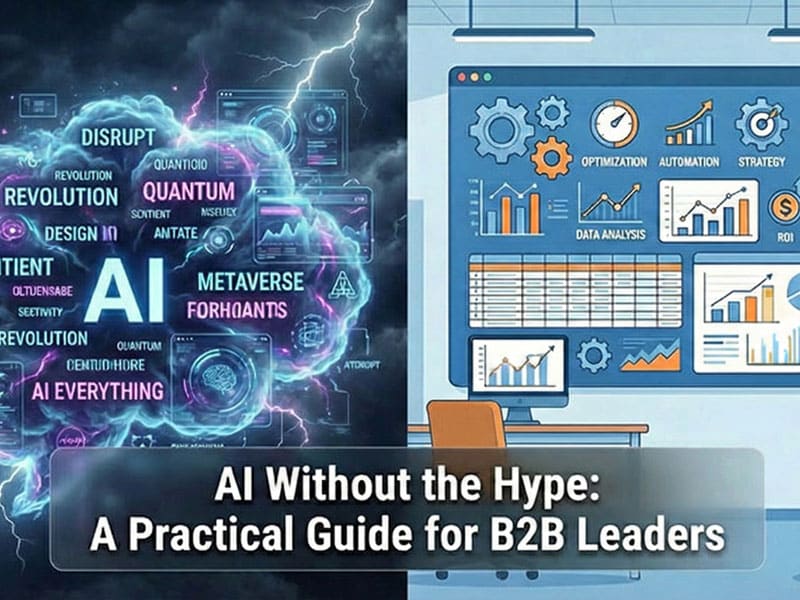
The boardroom pitch sounds familiar by now: AI will transform your business, automate workflows, and unlock unprecedented productivity gains. Fast forward twelve months, and leadership teams are staring at their dashboards asking an increasingly uncomfortable question: Where’s the money?
Here’s the plot twist nobody wants to talk about. According to recent industry research, 73% of organizations have deployed AI tools across their operations. Yet only 11% report achieving meaningful return on investment. Ouch.
This isn’t a technology problem. It’s a strategy problem wearing a technology costume.
The Subscription Trap (Or: How We Learned to Stop Worrying and Love Tool Sprawl)
Most companies approach AI the same way they approached SaaS a decade ago: subscribe first, strategize never. Marketing gets Jasper for content generation. Sales adopts Gong for call analysis. Engineering implements Copilot because, well, it’s Copilot. HR experiments with resume screeners that may or may not introduce bias they’ll discover two years later during an audit.
Within months, the organization is hemorrhaging budget on fifteen AI subscriptions with minimal cross-functional visibility and approximately zero unified strategy. Nobody knows what anyone else is using, but everyone’s definitely using something.
The result? Tool sprawl that fragments workflows instead of streamlining them. Teams spend more time managing AI tools than actually leveraging them. The promise of automation becomes the reality of “Wait, which AI are we using for this again?”
The Pilot Purgatory (Where Good Ideas Go to Die)
Even organizations that start with strategy often get stuck in what we’ll affectionately call pilot purgatory. They run successful proof of concepts. They achieve impressive departmental wins. Someone makes a slick presentation showing 40% time savings in widget categorization. The room applauds.
Then nothing happens.
Scaling hits a wall, usually courtesy of one of three culprits. First, lack of executive alignment. AI initiatives launched without clear business objectives tied to margin protection or revenue growth become orphaned projects the moment priorities shift or a new executive joins who “doesn’t really get AI.”
Second, insufficient change management. Turns out technology alone doesn’t drive adoption. Shocking, right? Teams need training, workflow redesign, and incentive alignment. Nobody wants to use your fancy AI tool if it makes their job harder or their metrics worse.
Third, terrible measurement frameworks. Vanity metrics like “number of AI queries” or “estimated time saved per task” sound impressive until someone asks how they connect to actual business outcomes. Reduced costs. Improved conversion rates. Faster time to market. You know, the stuff that shows up on financial statements.
The Hype Cycle Hangover (FOMO Is Not a Strategy)
When Gartner places generative AI at the peak of inflated expectations, it’s not just analyst commentary. It’s a flashing warning sign that most companies interpret as “buy faster.”
Companies chasing the latest model releases or racing to implement trending use cases aren’t solving business problems. They’re solving for FOMO. And FOMO has never been a particularly effective business strategy, despite what crypto bros might have told you in 2021.
The most successful AI implementations start with a ruthlessly simple question: What specific process is currently bleeding margin, creating bottlenecks, or limiting growth? Not “what’s the coolest thing ChatGPT can do” or “what did our competitor just announce.” What actual problem are we actually trying to solve?
Only after identifying that pressure point should technology evaluation begin. AI becomes a solution to a defined problem, not a very expensive hammer desperately searching for nails.
From Experiments to Enterprise Impact (The Actual Hard Part)
Bridging the gap between AI deployment and measurable ROI requires three fundamental shifts that sound simple but apparently aren’t, given that 89% of companies are getting this wrong.
First, strategy before spending. Revolutionary concept: map existing workflows, identify high-impact friction points, and build business cases tied to concrete financial metrics before evaluating any tools. We know, we know. Where’s the fun in that?
Second, adoption before automation. The best AI implementation means absolutely nothing if teams don’t use it. Invest in change management, workflow integration, and continuous training with the same rigor as technical deployment. Maybe even more rigor, since people are generally harder to configure than software.
Third, measurement that matters. Track metrics that connect to P&L impact: customer acquisition cost reduction, margin improvement, revenue per employee, cycle time compression. If you can’t draw a reasonably straight line from your AI investment to one of these outcomes, you might be tracking the wrong things.
The Bottom Line (See What We Did There?)
Organizations that treat AI as a strategic capability rather than a technology shopping spree are the ones turning pilots into profits. They’re not buying more tools. They’re building better systems. They’re not chasing hype. They’re chasing margin.
The AI adoption paradox isn’t evidence that the technology doesn’t work. It’s proof that implementation without strategy inevitably fails, no matter how sophisticated your models or how large your AI budget.
The companies closing the ROI gap aren’t the ones with the most tools or the biggest budgets. They’re the ones who asked better questions before writing the first check. Turns out that matters more than anyone wants to admit.
Let’s Talk AI – The Right Way
If you know you should be doing something with AI but don’t know where to start, we should talk.